
Top Signs You Need Air Duct Cleaning Service – Don’t Ignore These
Most homeowners look for dust, and dust is the worst clue in the house. A fine coat of dust settling on the furniture within a day or two of wiping it down usually points to a breach in the duct system pulling air from an attic or crawlspace, not to a duct full of dirt. Cleaning that system without sealing the breach leaves you exactly where you started. The signs that actually tell you something are more specific than most people expect, and reading them correctly is what separates a cleaning job from a repair job. If you’d rather have someone read the signs for you, call (855) 624-1395.
How Do You Tell the Difference Between Dirty Duckwork and a Duct Leak?
Location is the giveaway. Dust that collects around the edges of a supply register, forming a dark halo on the ceiling or a smudge line along the grille, is dust pulled in through a gap and pushed out at the joint. Even, uniform dust across the whole room, including surfaces nowhere near a vent, points to contamination inside the ducts themselves. Two different problems, two different fixes.
Air that leaks from a return-side gap in an attic or crawlspace carries whatever dust lives in that space: insulation fibers, soil, attic grime. The register edges take the visible hit first. A duct cleaning alone moves that air nowhere, because the hole is still there. This is why we treat Duct Repair & Sealing as a core service rather than an upsell. We seal gaps and reconnected joints with mastic and proper mechanical fastening, then verify airflow. A cleaning crew without that capability can only report the breach and leave, which is how homes end up paying twice.
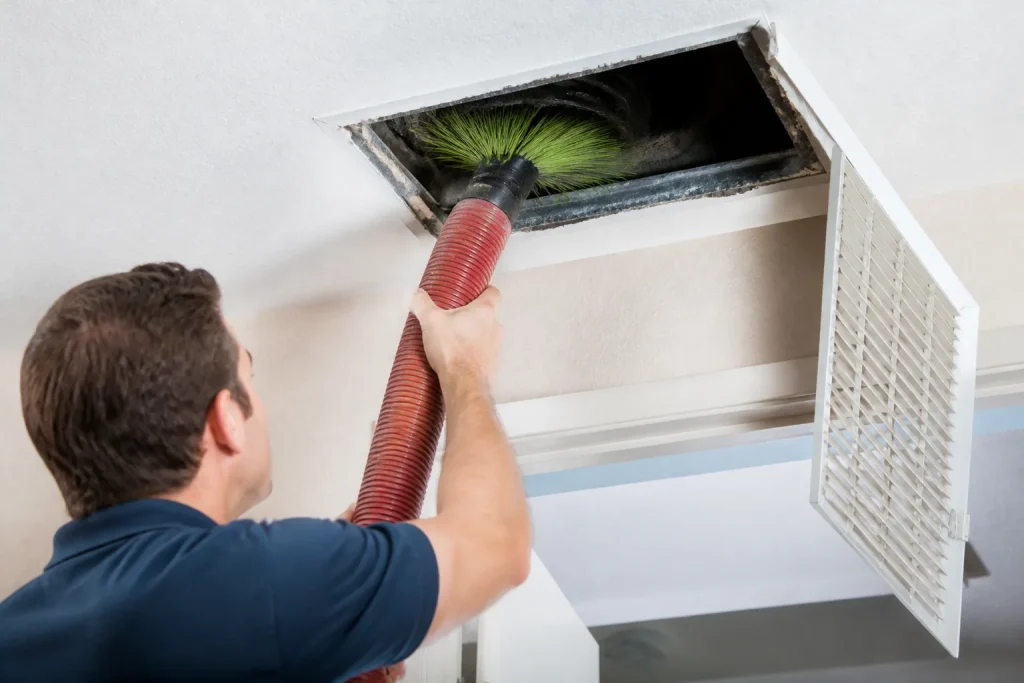
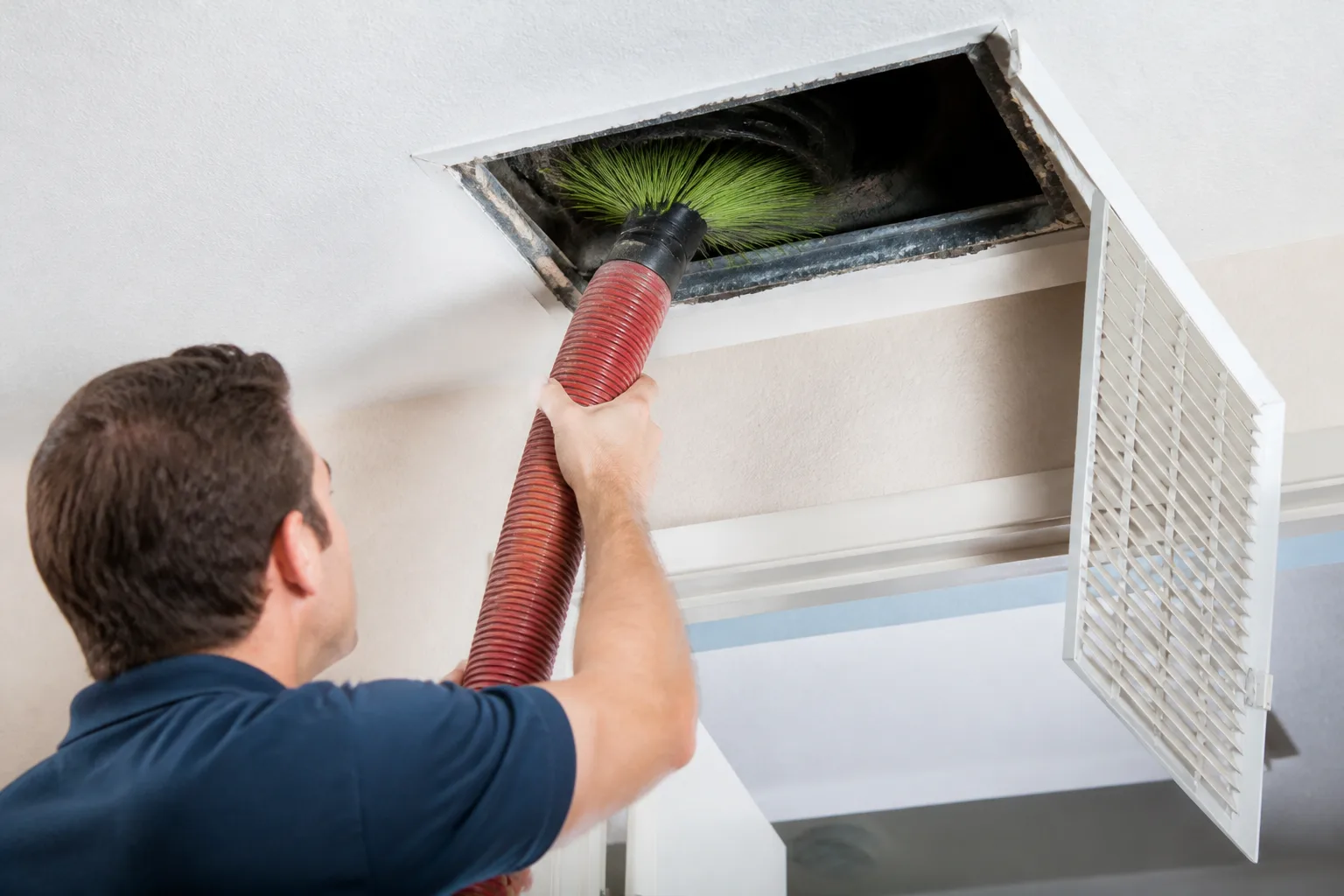
Uniform contamination has its own signature. It builds up where airflow is slow and turbulent, so it lands on duct walls, on the blower wheel, and on the evaporator coil rather than only at the grilles. That’s what a rotary brush and vacuum setup is built for, which is where Rotobrush and Nikro equipment come in. A shop vac duct cleaning doesn’t deliver the same result.
What Does a Musty Smell From Your Vents Actually Mean?
Timing tells you more than the smell. A musty odor that only appears during the first few minutes of a heating or cooling cycle is often a dormant condensate pan or a coil surface that’s stayed damp between cycles. Mustiness that never leaves once the humidity climbs is a different category entirely, usually active growth on the coil or on the fibrous liner inside the ducts. A smell coming from one or two registers while the rest of the house is fine suggests moisture entry or wildlife intrusion at that specific run.
- First startup only: dormant condensate, damp coil surface, or a wet pan that dries between cycles. Cleaning plus a drain-line check usually resolves it.
- Continuous in humid weather: active microbial growth on the coil or duct liner. Cleaning alone won’t fix it, and the source of the moisture has to be found.
- Single registers: localized intrusion or water entry, often where a run passes through an unconditioned space.
- Smell with dust at register edges: leaking system pulling airborne contaminants into the duct from an attic or crawlspace.
A musty smell is not a reason to panic, but it is a reason to stop guessing. Guardsman-grade sanitizing treatments applied after the ducts are cleaned address mold, bacteria, and allergens at the surface level, and Abatement Technologies air-scrubbing equipment keeps the air in the room clean during the work. Surface sanitizing without the moisture source addressed is a short-term fix, though, so the diagnostic has to come first.
Do Black Streaks Around Your Registers Mean Mold?
Not always, and this is where a lot of homes get sold a service they don’t need. The dark streaks often called ghosting are usually carbon tracking from candles, soot from a fireplace, or a gas range that hasn’t vented well. The carbon deposits as fine particles in the slow-moving air around a register, and it wipes off with a mild detergent. If you burn a lot of candles in Southlands during the winter, this is a live possibility.
The other version is microbial. It looks softer, spreads in irregular patches rather than following airflow lines, and often sits near a register that also smells musty. When you see that on a ceiling in Southlands, the likely culprit is condensation on a cold duct or liner, and the liner itself may be the habitat. Cleaning the duct wall without addressing the liner and the moisture doesn’t fix it. That’s where a mold assessment, abatement-grade tools, and a proper post-clean sanitizing treatment earn their place.
One rule of thumb for the homeowner: if the streaks reappear within a few weeks of a wipe-down, it’s not ordinary dust.
Why Is the Spring HVAC Switchover the Riskiest Window in Southlands?
Systems that ran heat all winter close registers and sit dormant through the shoulder season, and that’s when the contamination that’s been building all winter stops moving. Come spring, cool air hits warm duct surfaces and the system’s interior is at its most vulnerable. Condensation, dormant moisture, and the debris that collected through the heating season all come into play at the same moment. That first startup week is often when homeowners notice smells, uneven cooling, or fine dust settling around registers that they didn’t see in February.
In our experience, this is the moment where a routine duct and HVAC assessment does more good than it does at any other point in the year. We clean ducts, we clean the air handler as part of HVAC cleaning, and we verify the seals and connections all in one visit. One team, one assessment, and the whole-system picture in front of you. If a leak is present, it gets sealed. If a liner is compromised, it gets noted and addressed. Nothing gets passed to another contractor.
You’ll want to schedule this before the first warm week, not during it. Cooling systems work harder with obstruction, and the switchover is when people call.
How Do You Use an Air Quality Monitor to Decide if It’s Time to Act?
Get objective data instead of trusting your nose. A consumer air-quality monitor that reads PM2.5 (fine particulates) and VOCs (volatile organic compounds) gives you a baseline. Take a reading in a room served by the system, then compare it to the reading outdoors right after the system kicks on, and note what happens over two or three days. Rising PM2.5 that matches the system’s run cycles is a strong sign of debris or leakage reaching the living space. Elevated VOCs that don’t track with cooking, cleaning products, or new furniture are a hint that something else is off-gassing.
- PM2.5 spikes on startup: duct contamination, a leak, or a blower and filter problem.
- Sustained PM2.5 above outdoor levels in a closed room: system is not cleaning the air it moves.
- VOCs that don’t track with indoor activities: investigate with a proper assessment, don’t assume.
- Readings that stay clean: hold off, keep the filter changed, and recheck in a few months.
Monitors are guides, not gatekeepers. They tell you something is wrong; they don’t tell you where. A professional assessment with a camera inside the duct, an air-balance check, and a seal diagnosis fills in the rest. For a complete walkthrough of how the cleaning itself works, see our guide to air duct cleaning.
When Should You Call a Professional?
Call a professional when two or more signals match at once: dust at register edges plus a musty smell, black streaks that reappear after cleaning, uneven heating and cooling room to room, or a monitor that flags the system’s run cycles. A single soft signal on its own is often worth watching. Two that line up in the same week are worth a look.
We answer 24/7. Fast dispatch from 7am to 7pm, Sunday through Friday, so an assessment can usually be scheduled quickly. Estimates are free, and the price is set per job by the written estimate, so nothing is agreed until you’ve seen it on paper.
Related services in Southlands: if your dryer takes two cycles to dry a load or the vent has lint buildup you can see, that’s a fire-risk issue best handled alongside the ducts, handled by our dryer vent cleaning. If you’re seeing these signs across the whole system, our HVAC cleaning covers the air handler and coil side of the picture.
The Bottom Line
Dust, smell, and streaks mean different things depending on where they show up and when. Dust at register edges is a leak. Uniform dust is contamination. Smell on startup is usually moisture; smell all season points to growth. Black streaks that wipe clean are carbon; streaks that return are not. Reading the pattern saves you from paying for the wrong fix.
The full-system approach matters here: clean, seal, sanitize, and restore airflow in one visit, not two contractors and a guess in between. Our technicians have up to 14 years of experience, and we bring the professional-grade equipment through Air Duct Cleaning Southlands to handle the whole job. If these signs are lining up in your Southlands home, get a free estimate. Call (855) 624-1395.
Frequently Asked Questions
Most homes do well with an assessment every few years and a cleaning when the signs call for it. Homes with pets, recent remodeling, or anyone with respiratory sensitivity may want to look closer. Skip the calendar and use the signs.
Sometimes yes, sometimes no. If the cause is duct contamination reaching the living space, cleaning helps. If the cause is a leaky system pulling in attic or crawlspace air, sealing is needed. Call (855) 624-1395 for an assessment before assuming cleaning alone will do it.
You should be shown before-and-after photos of your own ducts, not a stock photo of someone else’s. Ask for the camera view of the inside of a run. Any team that won’t show you your own system’s interior hasn’t done the work you’re paying for.
A very low quote is often a surface pass: a shop vac and a quick sweep, no sealing, no sanitizing, no photos. Ask what the price covers in detail, and compare the scope, not the number. Cheap and thorough don’t share the same sentence.
Written by the team at Air Duct Cleaning Southlands.
Need Air Duct Cleaning Help?
Call Air Duct Cleaning Southlands - the local pro we connect you with is licensed and insured, with free written estimates in Southlands.
(855) 624-1395